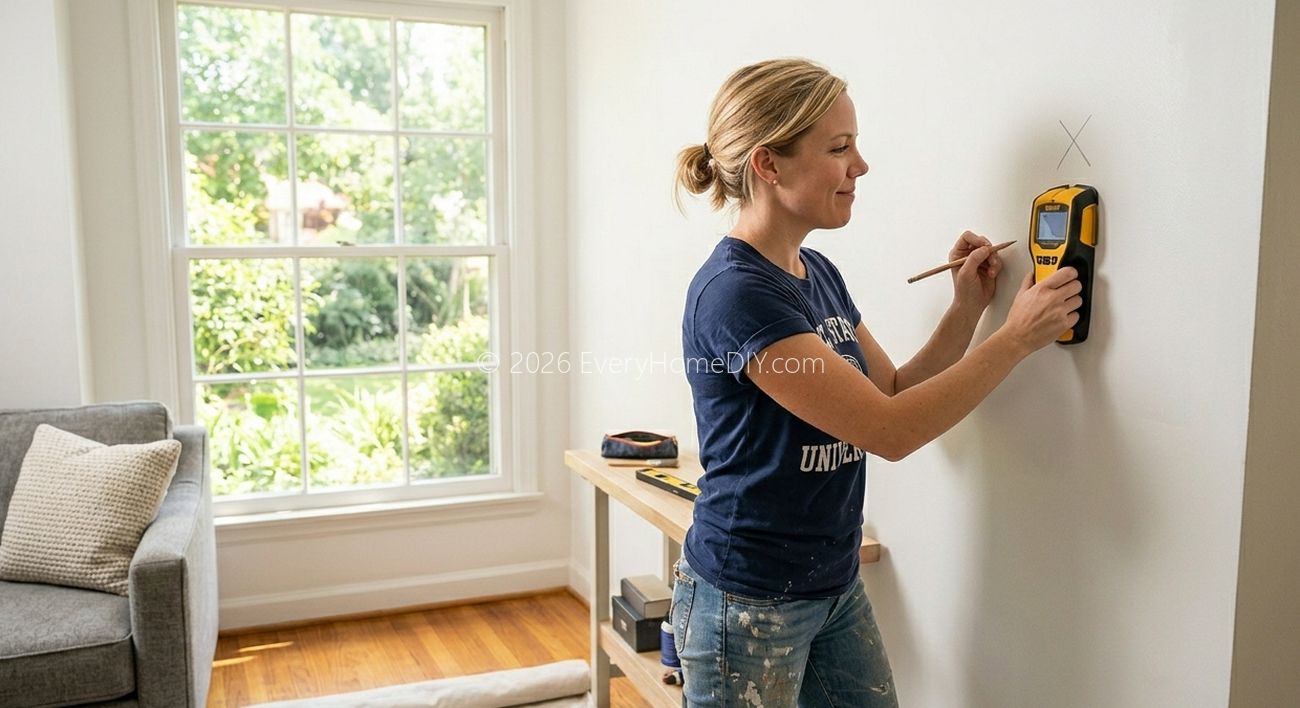
Why Most Cheap Stud Finders Fail
The $10 stud finders you find at dollar stores work by detecting changes in wall density. The problem is that textured paint, multiple layers of drywall, moisture, and inconsistent wall construction confuse them constantly. They beep in the middle of nowhere and miss actual studs entirely. The result: you drill into drywall thinking it's a stud, and your shelf mount fails.
Types of Stud Finders
Magnetic Stud Finders
These detect the metal screws and nails that fasten drywall to studs — not the wood itself. They're simple, never need batteries, and are surprisingly accurate when used correctly. Downside: they only find studs where fasteners are present, and they require more patience to use than electronic models.
Electronic (Capacitance) Stud Finders
Electronic stud finders detect changes in the dielectric constant of the wall as you slide them across. They're fast and show you the edges of studs so you can find center. Quality varies enormously between $15 and $50 models. Worth spending at least $25.
Deep Scan Stud Finders
These can see through thicker walls (up to 1.5 inches of drywall) and some can detect live electrical wires, metal pipes, and wood simultaneously. The most expensive category but genuinely useful in older homes with plaster walls.
1. Franklin ProSensor 710 — Best Overall
The Franklin ProSensor 710 is a paradigm shift in stud finding. Instead of a single sensor you slide across the wall, it uses 13 sensors simultaneously — you press it against the wall and it lights up LEDs showing exactly where stud edges and centers are. No more sliding back and forth hoping to catch a beep. It finds studs on the first try, every time, in virtually any wall condition. Slightly bulkier than traditional models but vastly more reliable.
Price: ~$40–50 | Works through: up to 1.5" drywall, plaster
2. Zircon MetalliScanner i520 — Best for Metal and AC Wires
If you need to find electrical wires or metal pipes in addition to wood studs, the Zircon i520 is the tool to own. It simultaneously scans for wood studs, metal objects, and live AC wires — and distinguishes between them with different indicator lights. Worth it for older homes where you need to know what's behind the wall before drilling.
3. C.H. Hanson 03040 Magnetic — Best Simple Option
For basic picture hanging and light shelving where you just need to find one stud occasionally, the C.H. Hanson magnetic stud finder is remarkably reliable for $10. No batteries, no calibration, no false readings. Slide it slowly across the wall and it clicks onto the screws holding your drywall in place.
Pro Tip: How to Find a Stud Without Any Tool
Knock on your wall as you move horizontally. A hollow sound changes to a slightly dull, solid sound at the stud location. Baseboards are nailed to studs — measure 16 inches from a corner (standard stud spacing) and check. Electrical outlets are almost always mounted to a stud on one side.